Introduction: Why Elevator Safety Myths Still Exist
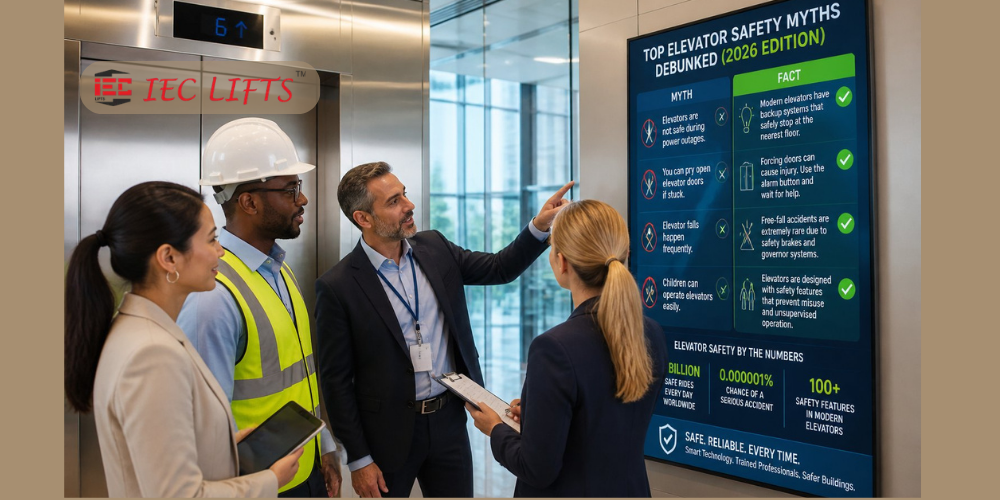
Despite elevators being one of the safest modes of vertical transportation, misinformation continues to circulate—especially in residential societies, commercial buildings, and older properties. These myths often lead to unnecessary fear, delayed maintenance, or poor decision-making during lift upgrades.
As a leading elevator solutions provider in India, IEC Lifts breaks down the most common myths and reveals truths backed by engineering, safety standards and real‑world data.
🧩 Myth 1: “Elevators Can Fall Like in Movies”
✔ Reality: Modern elevators cannot free‑fall.
Elevators are equipped with:
- Multiple steel suspension ropes where each rope alone can hold the full load
- Electromechanical brakes that automatically engage during power loss
- Overspeed governors that activate safety gear if the lift moves too fast
A free‑fall scenario is virtually impossible in modern traction and MRL elevators.
🧩 Myth 2: “Power Cuts Make Elevators Dangerous”
✔ Reality: Elevators are designed for safe evacuation during outages.
All IEC Lifts installations include:
- Automatic Rescue Device (ARD) to bring the lift to the nearest floor
- Battery backup for emergency lighting and ventilation
- Fail‑safe braking systems
Even in areas with frequent power cuts (like many Indian cities), elevators remain safe and predictable.
🧩 Myth 3: “Pressing the Alarm Will Make the Elevator Move”
✔ Reality: The alarm only alerts—not moves the lift.
The alarm button:
- Activates a buzzer or intercom
- Alerts security or maintenance teams
- Helps rescuers locate the stuck lift
It does not override safety systems or restart the elevator.
🧩 Myth 4: “Overloading Causes the Elevator to Crash”
✔ Reality: Overloading prevents movement—it doesn’t cause accidents.
When the lift exceeds its capacity:
- The overload sensor triggers
- Doors remain open
- The lift refuses to move until weight is reduced
This is a safety feature, not a risk.
🧩 Myth 5: “Jumping Inside the Elevator Is Harmless”
✔ Reality: Jumping can trigger safety locks or damage components.
Jumping may:
- Activate the overspeed governor
- Cause the lift to stop between floors
- Damage sensors or ropes over time
It won’t make the lift fall—but it can cause avoidable shutdowns.
🧩 Myth 6: “Elevators Are Unsafe for Senior Citizens”
✔ Reality: Elevators are the safest mobility option for seniors.
Modern home and residential lifts include:
- Smooth start/stop technology
- Anti‑jerk systems
- Handrails, emergency phones and ARD
For elderly residents, elevators reduce fall risks compared to stairs.
🧩 Myth 7: “Old Elevators Are Automatically Unsafe”
✔ Reality: Age doesn’t matter—maintenance does.
Even a 20‑year‑old elevator can be safe if:
- AMC is regularly performed
- Safety components are upgraded
- Controllers and wiring are modernized
IEC Lifts offers lift modernization that brings old elevators up to 2026 safety standards without replacing the entire system.
🧩 Myth 8: “MRL Elevators Are Less Safe Than Machine‑Room Lifts”
✔ Reality: MRL elevators meet same global safety standards.
MRL lifts are now dominant choice in 2026 because they offer:
- High energy efficiency
- Advanced safety gear
- Space‑saving design
- Lower maintenance requirements
Both MRL and traction lifts undergo identical safety certifications.
🧩 Myth 9: “Elevator Doors Can Crush You”
✔ Reality: Door sensors prevent accidents.
Modern elevators include:
- Infrared curtain sensors
- Mechanical safety edges
- Auto‑reverse technology
If something obstructs the door, it reopens instantly.
🧩 Myth 10: “Elevators Are More Dangerous Than Stairs”
✔ Reality: Elevators are statistically safer.
Global safety data shows:
- Elevator accidents are extremely rare
- Stair-related injuries are 100x more common
- Elevators undergo strict annual inspections
Elevators are engineered for predictable, controlled movement—unlike stairs.
🏆 Conclusion: Elevators Are Safer Than Most People Think
Most elevator fears come from outdated information or movie dramatization. With modern engineering, strict safety codes, and regular AMC, elevators remain one of the safest technologies in any building.
If your society, commercial building or home wants to ensure maximum safety, IEC Lifts provides:
- Certified installations
- Preventive maintenance
- Modernization upgrades
- 24/7 emergency support
Safe elevators start with the right knowledge and the right lift partner.