Industrial facilities often need to move raw materials, machinery, components, pallets, finished products, and sometimes personnel between different floors. Choosing the right industrial lift capacity is therefore important for maintaining smooth and safe material movement.
Among the most commonly considered capacities are 1-ton, 1.5-ton, and 2-ton industrial lift. While the difference may appear to be simply the amount of weight each lift can carry, selecting the right capacity involves several other factors, including load dimensions, frequency of use, building space, type of application, and future requirements.
IEC LIFTS provides industrial lifting solutions designed for different manufacturing, warehouse, engineering and industrial applications. Here is how to decide which capacity may be suitable for your facility.
Understanding Industrial Lift Capacity
Industrial lift capacity indicates the maximum rated load that lift is designed to carry.
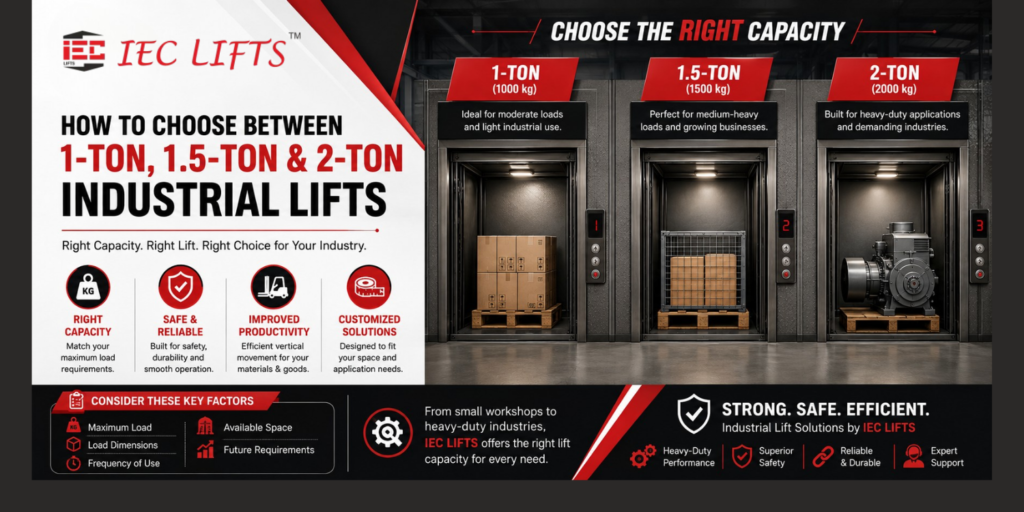
1-Ton Industrial Lift: Up to 1,000 kg
1.5-Ton Industrial Lift: Up to 1,500 kg
2-Ton Industrial Lift: Up to 2,000 kg
The capacity should always be selected according to the intended application and the lift’s specific design and safety requirements.
For example, if your facility regularly moves loads weighing 800–900 kg, a 1-ton lift may appear sufficient. However, if occasional loads are significantly heavier, a higher-capacity lift may be more appropriate.
1-Ton Industrial Lift: Suitable for Moderate Loads
A 1-ton industrial lift can be a practical option for facilities handling moderate-weight materials and equipment.
It may be suitable for:
* Small and medium manufacturing units
* Workshops
* Warehouses
* Engineering facilities
* Storage areas
* Light industrial applications
* Multi-level commercial-industrial buildings
Provided that the highest weight capacity is usually under 1,000 kilograms, then a 1-ton lift would be a more efficient way of handling vertical material transport.
Nevertheless, companies need to take into account more than just the weight. It is important to determine whether the size of the pallets, trolleys, machines or any other item will fit into the lift.
1.5-Ton Industrial Lift: A Practical Middle Option
A 1.5-ton industrial lift offers greater capacity for businesses whose requirements exceed what a 1-ton lift can comfortably handle.
With a rated capacity of up to 1,500 kg, it can be considered for applications involving:
* Heavy raw materials
* Industrial components
* Machinery parts
* Palletized goods
* Manufacturing equipment
* Finished products
* Industrial trolleys
In most manufacturing and engineering companies, 1.5 tons can be a good compromise between load capacity and operational needs.
In case your daily load is around 1 ton or if you anticipate increased material handling requirements in the future, a 1.5-ton lift will be able to accommodate that extra load.
2-Ton Industrial Lift: For Heavy-Duty Industrial Requirements
For facilities handling substantial loads, 2-ton industrial lift can be a suitable choice.
With a capacity of up to 2000 kg, it can be used for demanding applications involving:
* Heavy machinery
* Large industrial components
* Pallets containing heavy materials
* Manufacturing equipment
* Engineering products
* Raw materials
* Finished industrial goods
2-ton industrial lifts can prove very helpful in industrial areas such as manufacturing plants, engineering firms, big warehouses, fabrication shops, and other industrial sites where the need for lifting heavy materials from one floor to another arises.
For those firms that are going to expand in future or increase production, a more capable lift will help in many ways.
1-Ton vs 1.5-Ton vs 2-Ton Industrial Lifts
| Factor | 1-Ton | 1.5-Ton | 2-Ton |
|---|---|---|---|
| Maximum Rated Capacity | 1,000 kg | 1,500 kg | 2,000 kg |
| Typical Application | Moderate loads | Medium-heavy loads | Heavy-duty loads |
| Suitable Facilities | Workshops, warehouses | Manufacturing & engineering | Heavy manufacturing |
| Material Handling | Light to moderate | Moderate to heavy | Heavy |
| Future Flexibility | Moderate | Good | High |
The right choice depends on the actual requirements of the facility rather than simply selecting the highest available capacity.
5 Factors to Consider Before Choosing Lift Capacity
1. Maximum Load
Start by identifying the heaviest load that lift will need to carry. Do not calculate the requirement only from the average load.
If your facility occasionally needs to transport a 1700 kg machine or pallet, 1-ton or 1.5-ton lift would not be appropriate for that application.
2. Load Dimensions
A load can be within the weight limit but still be unsuitable if it does not fit properly inside the lift.
Consider the dimensions of:
* Pallets
* Trolleys
* Machinery
* Industrial carts
* Equipment
* Large components
Cabin/platform dimensions, door width and loading arrangements should be considered along with capacity.
3. Frequency of Use
The number of trips performed by the lift each day is another important consideration.
A lift used occasionally for material movement may have different requirements from one operating continuously in a busy manufacturing plant or warehouse.
Discuss your expected usage pattern with the lift manufacturer before finalizing the design.
4. Available Space
Industrial lift installation depends on the available site conditions. Factors such as shaft dimensions, pit, headroom, cabin/platform size, door arrangement, and structural requirements should be assessed before selecting the lift.
A higher-capacity lift may require different configuration, so site evaluation is important.
5. Future Requirements
Industrial activities can grow. The amount produced might go up; larger machines might be brought into use; or changes might take place concerning warehouse needs.
If you have a need that is approaching the capacity of 1-ton, using either 1.5 ton or 2 tons could give more latitude in the future.
What About Goods Cum Passenger Lifts?
Many industrial facilities need to move both materials and authorized personnel between floors. In such situations, goods cum passenger lift can be considered, depending on the application and applicable safety requirements.
These lifts can be useful in factories, manufacturing plants, warehouses and multi-storey industrial buildings where employees may need to accompany materials during vertical transportation.
The required capacity should be determined based on the combined operational requirements, load characteristics, passenger requirements, and site conditions.
Why Choose IEC LIFTS for Industrial Lifts?
IEC LIFTS offers industrial lift solutions for facilities that require dependable vertical movement of materials and personnel.
If you need an industrial lift of 1 ton, 1.5 tons, or even 2 tons of capacity, your choice should depend on your load, operating frequency, space, and application.
IEC LIFTS concentrates on practical requirements of industry in terms of load carrying capacity, accessibility, safety, working conditions, and performance.
Conclusion
Choosing between 1-ton, 1.5-ton and 2-ton industrial lift depends primarily on your operational requirements.
A 1-ton lift can be suitable for moderate loads, while 1.5-ton lift offers additional capacity for medium-heavy applications. When handling heavy machinery, equipment, pallets or industrial materials, a 2-ton lift may be more appropriate.
Before making the final decision, evaluate the maximum load, dimensions of the goods, frequency of operation, available installation space, and future requirements.
Looking for the right industrial lift for your facility? Contact IEC LIFTS to discuss your application and lift capacity requirements.