The manufacturing industry works across different floors, where it is necessary to move raw materials, mechanical parts, products, and equipment. The manual operation and the use of an inappropriate lifting mechanism will slow down the manufacturing process, make it labor-intensive, and cause health risks.
However, the industrial lift helps to solve the problem mentioned above. With the help of such a device, it is possible to deliver heavy loads in a fast and safe manner. Thus, it is crucial to choose the appropriate industrial lift for manufacturing plants in order to optimize the material handling process.
Why Do Multi-Floor Manufacturing Plants Need Industrial Lifts?
There are several production processes that are performed on different levels in the multi-floor manufacturing plant. Raw materials could be stored on the ground floor while production machinery could be installed on the first floor, and finished products should be delivered to the other floor.
Without a proper material-handling system, transporting these items can become time-consuming and physically demanding.
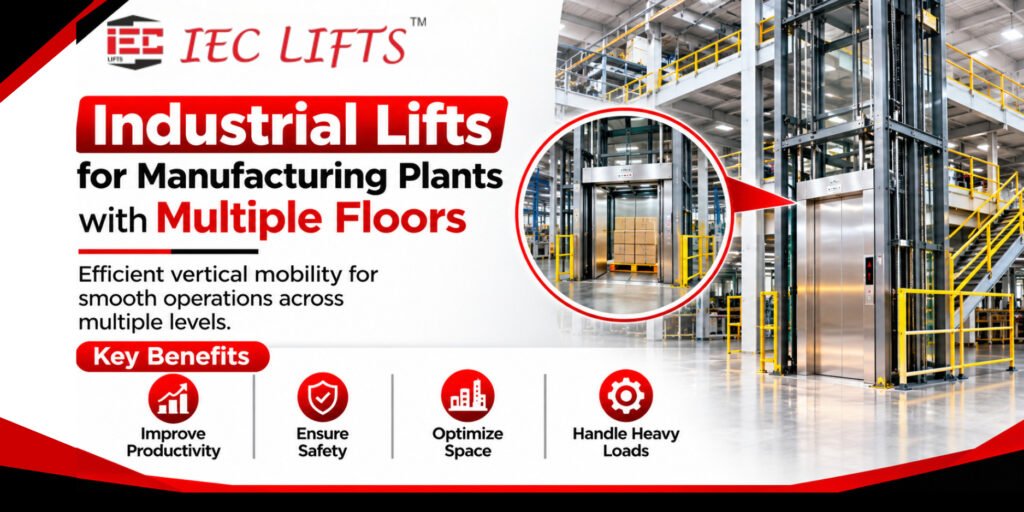
Industrial lifts help manufacturing facilities by offering:
– Efficient Material Transportation: Move heavy materials and finished products between multiple floors.
– Reduced Manual Handling: Minimise the need for workers to carry bulky or heavy items.
– Improved Productivity: Reduce material transportation time and support smoother production workflows.
– Better Space Utilization: Make it easier to use vertical storage and production areas.
– Operational Safety: Provide a controlled method of moving goods between different levels.
– Consistent Operations: Support regular material movement throughout manufacturing shifts.
Types of Industrial Lifts Suitable for Manufacturing Plants
Choosing the right industrial lift depends on the weight of materials, building structure, number of floors, available space, and frequency of operation.
Here are some commonly used industrial lift solutions for manufacturing facilities.
1. Goods Lifts
Goods lifts are designed to transport materials, raw products, machinery components, and finished goods between different floors.
They are particularly useful in manufacturing plants where heavy materials need to move regularly between storage, production, and dispatch departments.
Their load capacity and dimensions can be selected according to the specific requirements of the facility.
2. Heavy-Duty Industrial Lifts
Heavy-duty industrial lifts are suitable for manufacturing facilities that handle heavy machinery, large equipment, and high-weight materials.
These lifts are designed according to the required load capacity and operating conditions. They help industries transport bulky items without depending entirely on manual handling or forklifts.
3. Goods-Cum- Passenger Lifts
Some manufacturing facilities require a lifting solution that can accommodate both authorized personnel and goods.
Goods-cum-passenger lifts can be considered for such applications, subject to the lift design, safety requirements, and applicable regulations.
They provide a practical option for facilities where employees and materials need vertical transportation.
4. Hydraulic Industrial Lifts
Hydraulic lifts use hydraulic systems to raise and lower loads. They can be suitable for specific industrial applications where the building structure, travel height, and load requirements match the system’s design.
Before selecting a hydraulic lift, manufacturers should consider the required lifting capacity, floor height, installation space, and operating frequency.
Important Factors to Consider when Selecting an Industrial Lift
Installing an industrial lift requires proper planning. The selected system should match the manufacturing plant’s operational requirements.
Consider these important factors before making a decision.
1. Load-Carrying Capacity
2. Number of Floors and Travel Height
3. Platform and Cabin Dimensions
4. Available Installation Space
5. Frequency of Operation
6. Safety Features
How Industrial Lifts Improve Manufacturing Efficiency
Industrial lifts contribute to better coordination between different departments in a multi-floor manufacturing plant.
For example, consider a manufacturing facility where raw materials are stored on the ground floor, production takes place on the first floor, and finished products are stored on the second floor.
An appropriately designed goods lift can support the movement of materials through these stages.
This arrangement helps businesses:
– Reduce unnecessary material movement time.
– Improve coordination between production and storage departments.
– Minimise physical strain on workers.
– Support organized loading and unloading operations.
– Improve overall material-handling efficiency.
An industrial lift is therefore not just a transportation system. It is an important part of organized manufacturing workflow.
Why Choose IEC LIFTS for Industrial Lift Solutions?
The selection of the right lift manufacturing firm, which has experience in the business, is very important during the planning of vertical transportation in industrial facilities. Every industrial facility requires specific things to suit the requirements of the industrial facilities depending on the design of the facility, the type of material, and the weight of the material.
IEC LIFTS is a firm that provides the best solution for the various types of lifts available depending on the requirements of commercial and industrial purposes.
The appropriate lift system can help businesses manage the lifting of materials in vertical positions. During the planning of an industrial lift system, IEC LIFTS will provide some of the best solutions for some of the key things, including weight, height, platform size, and conditions.
The selection of a specific industrial lift is very important in case of setting up a new manufacturing facility or upgrades.
Conclusion
An important aspect of manufacturing operations that have to be considered in manufacturing units is industrial lifts, especially when they operate on multiple floors. Industrial lifts help make it easier to transport materials and make the process of material transfer from one place to another easier. But choosing an appropriate lift is not an easy task and requires thorough analysis of various factors such as load capacity, building design, travel distance, frequency, and safety.
An industrial lift solution from IEC LIFTS will ensure proper material handling for the manufacturing unit.
Do you need industrial lifts for your manufacturing unit? Connect with IEC LIFTS to get industrial lifting solutions for your manufacturing unit.
Frequently Asked Questions (FAQs)
Q1. Which industrial lift can be used for a multi-floor manufacturing plant?
There are two kinds of lifts that can be used in a multi-level manufacturing plant, namely, industrial goods lifts and heavy-duty industrial lifts.
Q2. What is the purpose of an industrial goods lift?
Industrial goods lifts are meant to transfer goods from one level to another in an industrial facility.
Q3. Are industrial lifts capable of moving machinery?
Yes, depending on its design, an industrial lift can be suitable to move machinery from one floor to another.
Q4. Which safety features are essential for industrial lifts?
Based on the design of the industrial lift, certain safety measures include overload protection, door interlock, emergency stop mechanism, limit switch, and control system, among others.
Q5. Why are industrial lifts helpful to manufacturing processes?
These lifts help to increase the efficiency of material movement within the manufacturing process since they take less time compared to manual handling.
Q6. Can you install industrial lifts in existing manufacturing plants?
The installation of industrial lifts in existing facilities requires that the building structure is suitable for installation of such equipment.